
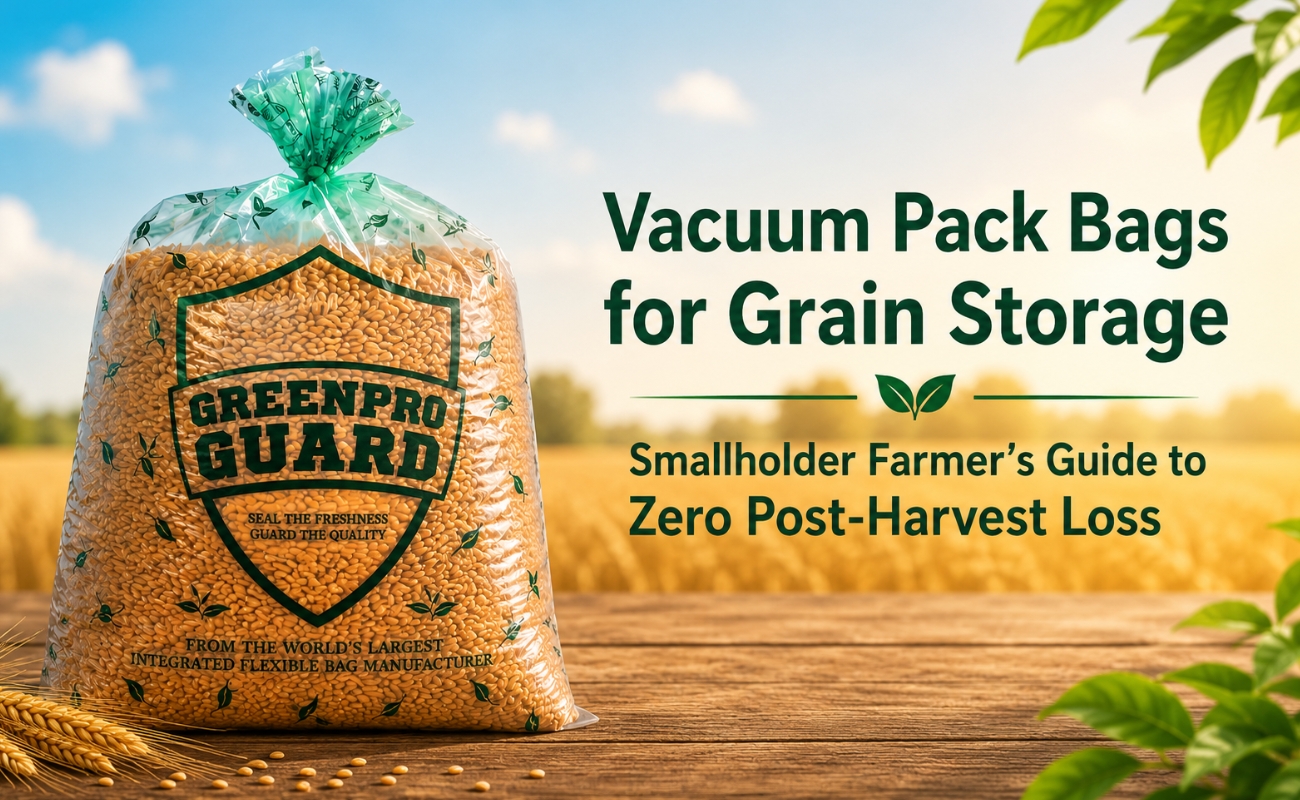
Preventing Post-Harvest Losses: How Vacuum Pack Bags Are Changing Lives for Smallholder Farmers
You worked the entire season. You planted, you watered, you waited. Harvest came, and it was good. But three months later, half your grain is gone. Eaten by weevils. Destroyed by moisture. Turned to dust by fungi. This is the reality millions of smallholder farmers live with every single year. The tragedy? It is almost entirely preventable. And the solution is simpler than most farmers think. Vacuum pack bags are the right kind, built for grain storage, and are quietly transforming how small farmers protect what they grow.
Why Post-Harvest Loss Is the Invisible Crisis Hurting Smallholder Farmers
Nobody talks enough about what happens after the harvest.
Globally, over 14% of food produced is lost between harvest and retail. For smallholder farmers in India and across South Asia, that number is often far higher. Some studies put grain storage losses at 20–30% per season for farmers using traditional storage — jute sacks, clay pots, open bins.
The causes are predictable. Insects like weevils and moths breed rapidly in stored grain. Moisture seeps into traditional containers, triggering mould and aflatoxin growth. Temperature fluctuations accelerate spoilage. Rodents do the rest.
The farmer absorbs every loss. Financially. Emotionally. Season after season.
What makes this harder is the timing. Post-harvest losses usually peak when prices are lowest — right after harvest, when supply is high. The farmer who loses grain cannot wait for better market prices. They sell early, cheap, or not at all.
This is where the conversation about hermetic storage becomes critical.
What Are Hermetic Bags and How Do They Actually Work?
Hermetic means airtight.
Hermetic bags work on one elegant principle: insects and fungi need oxygen to survive. Seal grain in an oxygen-deprived environment, and the biology of spoilage simply shuts down. No oxygen. No pest reproduction. No mould growth. No chemical fumigants needed.
The bag creates a sealed microenvironment. As residual insects inside consume available oxygen, CO₂ levels rise and oxygen depletes. The atmosphere becomes lethal to pests — naturally. The grain inside stays intact. Dry. Clean. Market-ready.
This is not experimental technology. Hermetic storage has been validated by agricultural research institutions, FAO, and development organisations across Africa, Asia, and Latin America. It works for rice, maize, wheat, lentils, sorghum, and most food grains.
How Vacuum Pack Bags Take Hermetic Storage a Step Further
Standard hermetic bags are effective. Vacuum pack bags go further.
Instead of passively waiting for insects to consume residual oxygen, vacuum sealing actively removes oxygen from the storage environment before sealing. The result is a near-zero oxygen atmosphere from day one. Pest development stops immediately. Moisture activity drops to near-zero. Grain quality is locked in at harvest levels.
For smallholder farmers storing high-value produce — basmati rice, specialty pulses, organic grains — vacuum pack bags are the gold standard. They extend safe storage from 3–4 months in traditional sacks to 12 months or more in proper hermetic conditions.
That extra time matters enormously. It gives farmers the market leverage they've never had before. Store now. Sell when prices are right.
Hermetic Storage Bags in India: Meeting the Farmer Where They Are
The adoption of hermetic storage bags in India has been growing steadily. And for good reason. India's climate — high humidity, temperature swings between seasons, monsoon moisture — creates some of the worst conditions for grain storage.
Farmers using jute or woven polypropylene bags in these conditions face near-certain losses. The bags breathe. And breathing bags let in moisture, insects, and contamination.
Hermetic bags seal all of that out.
What's encouraging is that hermetic solutions are now available at farmer-friendly scales — from 10 kg bags for home consumption to multi-quintal liners for community storage and FPO-level grain aggregation. Technology that was once only accessible to large agribusinesses is reaching the last mile.
Practical Benefits Farmers See — Season After Season
Let's make this concrete. Here is what smallholder farmers consistently report after switching to hermetic and vacuum seal bags:
- Zero chemical use. No fumigants. No pesticide residues. Clean grain that meets export-grade standards.
- Longer storage life. Rice and wheat stored hermetically stay fresh for 10–12 months. Traditional bags rarely manage 3–4 months without significant loss.
- Better selling prices. Farmers who can store longer sell when the market peaks — not when they're desperate. Average price gains of 15–30% have been documented in several adoption studies.
- Reduced aflatoxin risk. Hermetic conditions prevent the mould growth that produces aflatoxin — a major cause of rejected exports and food safety rejections in Indian markets.
- Simplicity. No electricity. No refrigeration. No sophisticated infrastructure. A good hermetic bag, sealed correctly, does the job.
What to Look for in a Quality Hermetic or Vacuum Pack Bag
Not all bags marketed as "hermetic" deliver true hermetic performance. Here's what matters:
- Multi-layer barrier construction. Look for bags with at least three layers — typically polyamide and polyethylene combinations — that block oxygen and moisture transmission effectively.
- Weld-sealed seams. Heat-sealed or weld-bonded seams prevent the micro-leaks that standard stitched bags allow.
- UV resistance. For outdoor or semi-outdoor storage, UV-stable outer layers protect bag integrity over extended periods.
- Certified burst and puncture resistance. Grain weight puts pressure on bags. Structural weakness leads to seal failure — and seal failure means spoilage.
This is precisely the standard that GreenPro Guard vacuum pack bags are built to meet.
🌾 Protect Your Harvest. Protect Your Income. Choose GreenPro Guard.
You grew it. You earned it. Don't lose it to poor storage.
GreenPro Guard offers high-performance hermetic bags, vacuum seal bags, and hermetic storage bags designed specifically for Indian farming conditions. Built with multi-layer barrier technology, weld-sealed seams, and UV-stable materials, GreenPro Guard packaging keeps your grain — and your income — secure from harvest to market.
Whether you're an individual smallholder farmer, a Farmer Producer Organisation (FPO), or an agri-cooperative managing community storage, GreenPro Guard has a hermetic storage solution scaled to your needs.
Your harvest is your hardest work. Guard it like it matters — because it does.
👉 Reach out to GreenPro Guard today and find the right hermetic storage solution for your crop and region.
Vacuum pack bags actively remove oxygen from the storage environment before sealing. This creates an atmosphere hostile to insects and mould — the two primary drivers of post-harvest grain losses. For smallholder farmers, vacuum pack bags extend safe storage life from 3–4 months to 10–12 months without any chemical fumigants.
Yes. Hermetic bags store grain without any chemical treatment. They work by eliminating oxygen — the element pests and mould need to survive. This makes grain stored in hermetic storage bags safe for human consumption, export-grade certification, and organic labelling — an important advantage for premium grain markets in India.
Hermetic storage bags in India are increasingly available through agri-input dealers, FPO networks, government schemes, and direct suppliers like GreenPro Guard. Bags are now available in sizes suitable for individual households, community storage, and larger agri-cooperative operations — making hermetic storage accessible at every farm scale.
When properly sealed, vacuum seal bags can maintain grain quality for 10–12 months under standard ambient conditions. The key is ensuring the bag is correctly sealed at harvest with dry grain — moisture content should be at or below safe storage thresholds before sealing to achieve maximum storage life.
Recent Posts

Coffee Harvest 2027/28: Set Up Your Green Coffee Storage Before Picking Starts

How Do Storage Grain Losses Occur? 6 Causes and How Hermetic Bags for Grain Storage Stop Them

Common Storage Challenges Solved by Hermetic Container Liners
Tags
0266-222-7100 / 200
marketing@rishifibc.com