

How Hermetic Storage Prevents Moisture Damage in the Indian Climate
India produces over 300 million tonnes of food grains every year. Yet a significant portion never reaches the consumer. Post-harvest losses continue to cost the country billions of rupees annually. At the center of this problem is one invisible enemy: moisture.
The Indian climate is among the most challenging environments for grain storage worldwide. From the heavy monsoon rains of Kerala and Assam to the humid coastal belts of Andhra Pradesh and Odisha, air moisture levels can swing dramatically within days. Even in semi-arid regions like Rajasthan, nighttime temperature drops cause condensation inside storage structures.
Traditional storage methods were designed for a different era. Today, with climate patterns becoming more unpredictable, farmers and warehouse operators need a storage solution that actively seals grain away from moisture. Hermetic storage is that solution. It is scientifically proven, chemical-free, and built for the realities of Indian agriculture.
Why Moisture Is Dangerous for Stored Grains
Moisture does not just make grain wet. It triggers a chain of biological and chemical events that destroy quality from the inside out.
- Mold Growth and Mycotoxin Contamination
When grain moisture content rises above 13 to 14 percent, fungal spores become active. Molds like Aspergillus and Fusarium spread rapidly in warm, humid storage spaces. These molds produce mycotoxins, which are toxic compounds that make grain unfit for human consumption and unsafe for animal feed. Mycotoxin-contaminated grain is rejected in domestic and international markets. - Grain Spoilage and Dry Matter Loss
Moist grain respires faster. Respiration burns stored carbohydrates and produces heat, carbon dioxide, and more moisture. This creates a self-reinforcing cycle of deterioration. Grain loses dry weight steadily, which directly translates to weight loss and lower market returns. - Pest Infestation
Insects like the rice weevil, lesser grain borer, and khapra beetle thrive in humid environments. Moisture softens the grain seed coat, making it easier for insects to penetrate and feed. A single infested bag can contaminate an entire warehouse within weeks if storage conditions allow insects to breed freely. - Reduced Germination and Seed Quality
For farmers who store seed grain for the next planting season, moisture damage is particularly devastating. High humidity accelerates enzymatic breakdown inside seeds. Germination rates fall sharply, forcing farmers to purchase fresh seed at higher costs. - Loss of Market Value and Export Rejection
Moisture-damaged grain fails quality grading standards. Exporters regularly face rejections at international ports because of elevated moisture content or mycotoxin levels. Once a consignment is rejected, the financial and reputational damage can be severe.
Challenges of Grain Storage in the Indian Climate
India does not have a single climate. It has dozens of microclimates, each posing different storage challenges. Understanding these conditions is essential before choosing the right storage system.
-
- High Humidity Coastal and Northeast Regions
States like West Bengal, Assam, Kerala, and coastal Andhra Pradesh experience relative humidity levels above 80 percent for extended periods. In these regions, grain absorbs moisture from the surrounding air even when stored indoors. Traditional jute bags and open storage provide no barrier against humid air.
-
- Monsoon Moisture Infiltration
During the monsoon months from June to September, humidity spikes sharply across the entire subcontinent. Even warehouses in relatively dry regions experience dangerous humidity levels during this period. Water can seep through floors, walls, and roofs, reaching grain stored in non-sealed containers.
-
- Condensation Inside Warehouses
Temperature fluctuations between day and night cause warm humid air inside a warehouse to cool and condense on grain surfaces. This is especially common in metal-roofed rural godowns, where temperatures can vary by 15 to 20 degrees Celsius between morning and afternoon. Condensation adds localized moisture to grain that may otherwise be within safe limits.
-
- Poor Ventilation in Traditional Storage Structures
Many village-level storage structures, such as kothi bins, mud silos, and jute-covered stacks, do not allow for adequate airflow management. Stagnant, moist air trapped inside these spaces creates ideal conditions for mold and insect activity. Adding ventilation without humidity control can sometimes make the situation worse by drawing in outdoor moisture.
What Is Hermetic Storage?
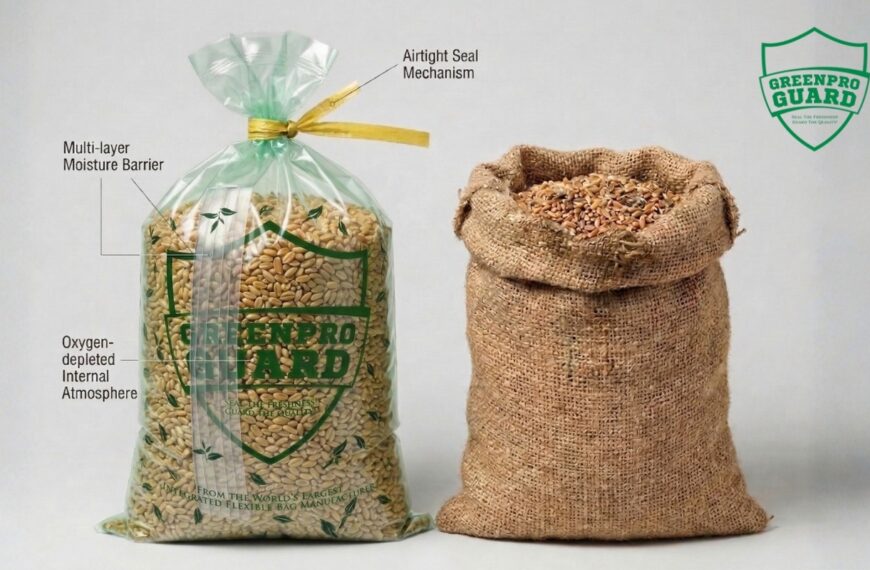
Hermetic storage is the practice of sealing grain in an airtight environment that completely isolates it from outside air and moisture. The word hermetic comes from the concept of an airtight seal, named after the ancient principle of trapping and stabilizing a controlled atmosphere.
In a hermetic storage system, grain is placed inside an impermeable container such as a hermetic bag or a sealed silo. Once sealed, no air enters or exits. The grain continues to respire briefly, consuming the available oxygen inside the container. As oxygen levels fall below 2 percent and carbon dioxide levels rise, all biological activity inside the container slows dramatically.
This modified internal atmosphere achieves three critical outcomes at once. It stops moisture from entering from outside. It prevents the grain’s own respiratory moisture from building up dangerously. And it creates conditions in which insects and molds cannot survive. All of this happens without a single gram of chemical pesticide or fumigant.
How Hermetic Storage Prevents Moisture Damage Complete Moisture Barrier
The core advantage of hermetic storage is its impermeable barrier. High-quality hermetic bags are made from multiple layers of specialized polymer films with extremely low water vapor transmission rates. External humidity, whether from monsoon air, condensation, or water seepage, cannot penetrate the bag wall. The grain inside remains at the moisture content it had at the time of sealing.
-
- Stabilized Internal Atmosphere
Inside a sealed hermetic bag, the grain and associated microorganisms consume oxygen during initial respiration. This rapidly depletes available oxygen and replaces it with carbon dioxide. The resulting low-oxygen, high-carbon dioxide atmosphere halts all further respiration, mold activity, and insect development. Moisture generation from respiration is therefore stopped at its source.
-
- Suppression of Insects Without Chemicals
Insects require oxygen to survive. In a hermetic environment where oxygen falls below 2 percent, insects at all life stages including eggs, larvae, pupae, and adults are eliminated within days to weeks. There is no need for phosphine fumigation, malathion dust, or any other chemical treatment. This is particularly valuable for organic grain producers and exporters targeting markets that require chemical-free certification.
-
- Long-Term Quality Preservation
Because moisture, mold, and insects are all controlled simultaneously, grain stored in hermetic conditions retains its physical and nutritional properties for significantly longer periods than grain stored conventionally. Color, texture, aroma, and nutritional value are preserved. This directly protects the commercial grade and market price of the stored commodity.
Real-World Applications Across the Coffee Supply Chain
Among the various hermetic storage technologies available, hermetic bags have emerged as the most practical and scalable solution for India. They bridge the gap between large industrial silos and the traditional, informal storage systems used by smallholder farmers and medium-scale traders.
Hermetic storage bags in India are now available in a wide range of sizes, from 50 kg capacity bags suitable for individual farm families to 1-tonne and 2-tonne capacity bags used by grain aggregators, cooperatives, and warehouse operators. The bags are reusable for multiple seasons when handled correctly, making the per-kilogram storage cost highly competitive with conventional alternatives.
Grain storage bags made with hermetic technology are designed for Indian field conditions. They can be used on the farm, in village-level collection centres, in Food Corporation of India warehouses, and at export-ready cold chain facilities. Their portability and scalability mean that a single technology solution can serve the entire grain supply chain from harvest to final sale.
For agricultural exporters, hermetic storage bags provide documented, verifiable evidence of chemical-free storage. Many export markets now require declarations of storage methodology. A sealed hermetic bag with an intact seal provides strong evidence of uncontaminated, moisture-controlled storage throughout the post-harvest period.
Practical Benefits for Farmers and Exporters
Hermetic FIBC bags align with sustainability goals by enabling reuse across multiple shipping cycles. Quality preservation packaging for specialty coffee reduces spoilage and waste, supporting circular economy principles. Reduced product loss benefits the entire supply chain—from farmers whose quality work is preserved, to roasters showcasing origin characteristics, to consumers experiencing coffee as intended.
Protect Your Coffee Investment
For Farmers:
-
- Longer shelf life allows farmers to store grain past the harvest glut and sell when prices recover
- Reduced post-harvest losses directly improves net income per acre
- No chemical inputs means safer grain for household consumption and local markets
- Seed storage in hermetic conditions preserves germination rates for the next planting season
- Low-cost entry point with 50 kg and 100 kg hermetic bags accessible even for marginal farmers
For Grain Traders and Warehouse Operators:
-
- Predictable quality maintenance reduces grade downgrading and buyer disputes
- Elimination of chemical fumigation reduces costs and compliance complexity
- Hermetic storage is compatible with organic and natural certification schemes
- Reduced inventory shrinkage improves warehouse profitability and client trust
For Agricultural Exporters:
-
- Consistent moisture content below international threshold limits prevents port rejection
- Chemical-free storage documentation supports market access in the EU, Japan, and Southeast Asia
- Improved grain appearance and nutritional profile command premium pricing
- Traceable storage methodology strengthens compliance with FSSAI and international SPS requirements
Make Hermetic Storage the Foundation of Your Post-Harvest Strategy
India’s agricultural economy loses thousands of crores of rupees to post-harvest grain damage every year. A significant share of these losses is attributable to moisture. The monsoon climate, high ambient humidity, poor ventilation in traditional structures, and temperature-driven condensation all contribute to rapid grain deterioration.
Hermetic storage breaks this cycle. By creating a sealed, moisture-controlled, low-oxygen environment, hermetic technology protects grain from the moment it is sealed until the moment it is sold. No chemicals are required. No elaborate infrastructure is needed. And the technology scales from a single farming family to a national grain reserve.
Whether you are a smallholder farmer in Bihar, a grain trader in Punjab, a warehouse operator in Maharashtra, or an exporter preparing consignments for overseas buyers, hermetic storage bags offer a proven, practical answer to India’s moisture challenge. The investment in hermetic protection is an investment in the full value of your harvest.
India’s grain does not have to be lost to moisture. The technology to prevent it is available, affordable, and ready to use today.
FAQ
Hermetic storage seals grain in an airtight container, preventing moisture and oxygen from entering. The grain’s own respiration depletes oxygen inside, creating conditions that stop mold growth, insect activity, and moisture damage without any chemicals.
Yes. Hermetic bags are specifically effective in high-humidity monsoon climates. Their multi-layer polymer construction blocks external moisture from entering, keeping grain at the safe moisture level it had when sealed, regardless of outside humidity.
Hermetic bags eliminate the need for chemical fumigants by creating a low-oxygen environment that kills insects naturally. They are recognized as a chemical-free alternative suitable for organic produce and export markets that require pesticide-free certification.
With proper sealing and handling, hermetic bags can preserve grain quality for 12 to 18 months or longer. Duration depends on initial grain moisture content, temperature, and bag integrity. Grain must be dry before sealing for best results.
Hermetic storage bags from India suppliers are available in sizes ranging from 50 kg family-scale bags to 1-tonne and 2-tonne commercial bags. This range makes hermetic storage accessible for individual farmers, cooperatives, grain traders, and large-scale warehouse operations across India.