
How Hermetic FIBC Bags Simplify Bulk Coffee Shipping for Coffee Exporters
Global coffee trade has never moved at a faster pace. Coffee exporters are shipping larger volumes to more destinations than ever before, and the pressure to deliver consistent quality at scale is growing every season. Yet behind the scenes, one critical challenge keeps resurfacing: how do you protect millions of kilograms of coffee across weeks of ocean transit, port handling, and temperature fluctuations without losing quality or profit margins? The answer, increasingly adopted by top coffee exporters worldwide, is hermetic FIBC bags.
The scale of the problem in bulk coffee shipping
Coffee is a living commodity. Even after processing, green coffee beans continue to respire, interact with oxygen, and absorb moisture from their surroundings. Over a standard 20- to 35-day shipping cycle from ports in India, Ethiopia, or Brazil to buyers in Europe or North America, a poorly packaged lot can deteriorate significantly. The buyer receives coffee that smells stale, tastes flat, or shows signs of mold. Claims follow. Trust erodes.
For large-scale exporters and coffee manufacturers in India managing shipments of 20 to 100 metric tonnes per container, these losses are not small. They add up shipment after shipment, season after season.
A single container of specialty coffee lost to moisture or mold is not just a financial loss. It is a relationship loss with a buyer who may not return.
Why traditional packaging falls short
For generations, the coffee industry relied on jute bags. A standard 60 kg jute sack is familiar, affordable, and easy to source. But it was never designed for the demands of modern global logistics. Jute breathes, which means moisture passes through it freely. In humid port environments or refrigerated shipping containers with temperature swings, condensation forms on and inside jute bags. Beans absorb that moisture within hours.
Beyond moisture, jute bags offer no protection against pests. Weevils and beetles can penetrate the weave. Fumigation with chemical agents like methyl bromide becomes necessary, adding cost and raising concerns for buyers in markets with strict chemical residue regulations. Loading and unloading hundreds of individual 60 kg bags from a container is also labor-intensive, time-consuming, and physically demanding for port workers.
What are hermetic FIBC bags?
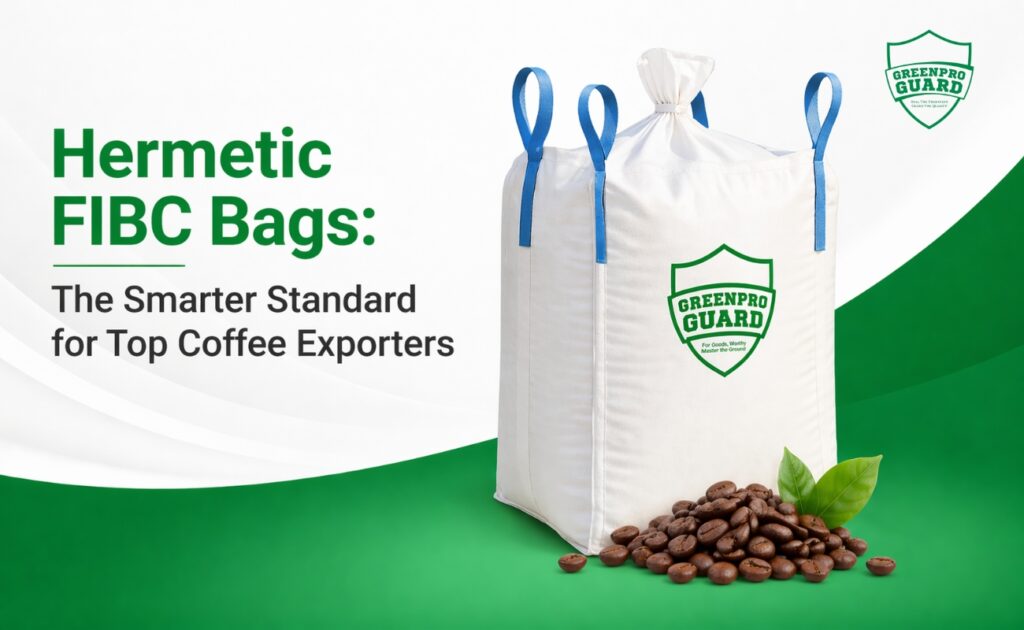
FIBC stands for Flexible Intermediate Bulk Container. Hermetic FIBC bags combine the large capacity of industrial bulk bags with an airtight inner liner that creates a sealed, oxygen-reduced environment around the coffee. A single hermetic FIBC bag typically holds between 500 kg and 1,000 kg of green coffee, replacing dozens of conventional sacks.
The hermetic liner, usually made from multi-layer barrier film, prevents air exchange between the coffee and its external environment. Once sealed, oxygen inside the bag is gradually consumed by the natural respiration of the beans. Oxygen levels drop below the threshold at which mold, fungi, and most pests can survive. The result is modified atmosphere storage without any chemical input.
How hermetic FIBC bags simplify coffee export logistics
The operational impact on export workflows is immediate and measurable. Loading a container with large-format hermetic FIBC bags requires fewer lifts, fewer workers, and less time. A shipment that previously required four to six hours to load into individual jute sacks can be handled in a fraction of that time using bulk bags and a forklift or crane. This directly reduces port handling costs and turnaround time at loading terminals.
Container space is used more efficiently as well. Hermetic FIBC bags confirm and stack with minimal wasted volume. Exporters report better cubic utilization per container, which in high-freight-cost environments translates to meaningful savings per shipment.
At the destination, unloading follows the same logic. Buyers and roasters receiving large-format bags can move product into warehouse storage quickly, reducing dwell time and labor dependency at receiving docks.
Protection benefits that preserve quality and value
- Moisture control
Airtight liner prevents humidity ingress throughout the shipping duration.
- Moisture control
- Mold prevention
A low-oxygen environment naturally stops fungal and bacterial growth.
- Mold prevention
- Chemical-free pest control
No fumigation is required to meet the importing country’s strict import regulations.
- Chemical-free pest control
- Aroma and flavor retention
A sealed atmosphere preserves volatile aromatics during transit.
- Aroma and flavor retention
- Batch consistency
Every unit in the shipment arrives in the same condition as it left.
- Batch consistency
Why top coffee exporters are making the shift
Specialty coffee buyers and commodity roasters alike are becoming more demanding about receiving documentation that confirms packaging integrity. Hermetic FIBC bags support better traceability because each large unit represents a defined lot that can be tracked, sampled, and certified more easily than dozens of individual jute sacks.
For coffee manufacturers in India exporting to regulated markets in the European Union, Japan, or the United States, chemical-free storage is increasingly a compliance requirement rather than a preference. Hermetic packaging removes the fumigation variable entirely, simplifying customs documentation and reducing the risk of shipment rejection at destination ports.
There is also a sustainability dimension. Bulk packaging reduces the total material consumed per kilogram of coffee shipped. Fewer bags, fewer wooden pallets, and less secondary packaging material mean a lower carbon footprint per export container.
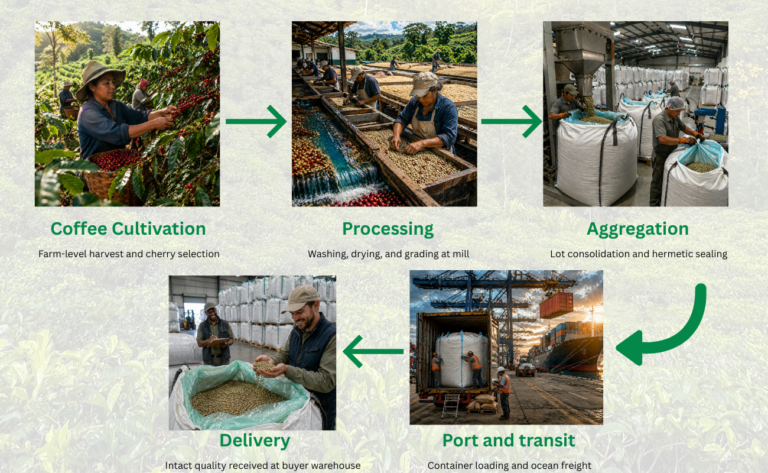
From coffee cultivation to export: the full journey
This end-to-end integration means hermetic packaging does not just protect coffee during the ship voyage. It maintains integrity from the moment the lot is sealed at origin through final delivery, no matter how many times the container is transferred between vessels, trucks, or warehouses along the route.
The business case is clear
Fewer rejected shipments. Lower labor costs at loading and unloading. No fumigation expenses. Better quality scores from buyers. Stronger compliance documentation. These are not theoretical benefits. They are outcomes being recorded by exporters who have made the transition from conventional jute sacks to hermetic FIBC bags in their export operations.
As global coffee trade continues to grow and buyer expectations continue to rise, the question for exporters is no longer whether to adopt hermetic bulk packaging. It is how quickly they can make the transition.
Ready to protect your coffee and simplify your export operations? Enquire About Hermetic FIBC Bags with Greenpro Guard.
FAQ
Hermetic storage is the leading green coffee storage solution in 2026. Hermetic bags and container liners create airtight, oxygen-depleted environments that prevent moisture damage, mold growth, pest infestation, and flavor loss during long international shipping cycles.
A hermetic container liner seals the entire interior of a shipping container, isolating coffee from external humidity and condensation. This prevents container rain and moisture ingress across long voyages, protecting bulk green coffee through multiple climate zones without chemical treatment.
Yes. Hermetic bags eliminate oxygen inside the sealed environment, killing insects at all life stages without fumigants. This supports organic and chemical-free certification, satisfies phytosanitary requirements at destination ports, and removes fumigant residue concerns for sensitive import markets.
Green coffee stored in properly sealed hermetic bags maintains export grade quality for 12 to 18 months or longer when initial moisture content is within safe limits. This extends the exporter’s selling window and reduces pressure to sell at harvest season low prices.
Ocean containers experience condensation when temperature fluctuations convert humid trapped air into water droplets that fall onto cargo. Moisture raises coffee moisture content above safe thresholds, triggering mold, mycotoxin development, and grade downgrading that can result in full shipment rejection.