
Best Storage Solution for Green Coffee Exporters in 2026
Global demand for specialty and single-origin green coffee continues to rise. Buyers in Europe, Japan, the United States, and the Middle East are paying premium prices but also enforcing stricter quality standards than ever before. A shipment that leaves a Colombian highlands farm or an Ethiopian washing station in perfect condition can arrive at the destination port with degraded flavor, elevated moisture, and compromised market value.
The problem is not the coffee. The problem is how it is stored and shipped.
For green coffee exporters in 2026, the storage decision made before loading a container is among the most consequential in the entire supply chain. This blog explains the core risks, the failure of traditional methods, and why hermetic technology has become the definitive green coffee storage solution for exporters who want to protect quality and profitability across long international transit cycles.
Why Green Coffee Storage Is a Critical Issue in Global Trade
Green coffee is a living, breathing commodity. It continues to interact with its environment long after harvest and processing. This biological activity is both an asset and a liability. Stored well, green coffee retains the complex flavor compounds that make specialty grades valuable. Stored poorly, it degrades in ways that cannot be reversed.
- Moisture Damage
Ocean shipping routes pass through multiple climate zones. A container traveling from Mombasa to Rotterdam crosses tropical heat, equatorial humidity, and North Sea cold. Temperature fluctuations inside a sealed container cause condensation, popularly called container rain. Moisture droplets fall directly onto grain sacks, raising moisture content and triggering mold growth within days. - Mold and Mycotoxin Risk
When green coffee moisture content exceeds 12 to 13 percent, fungal growth accelerates rapidly. Ochratoxin A, a carcinogenic mycotoxin produced by Aspergillus molds, is one of the most serious contamination risks in coffee export. Consignments found to contain mycotoxin levels above EU regulatory limits are destroyed at the importer’s expense, with full financial loss falling on the exporter. - Flavor and Aroma Deterioration
Green coffee aroma compounds are volatile. Oxygen exposure oxidizes the lipids and aromatics inside the bean. A coffee that tested brilliantly at the origin cupping table can arrive at the roaster tasting flat, woody, or papery. This aroma and flavor loss is cumulative and irreversible. It directly depresses the cup score and the price a roaster is willing to pay. - Pest Contamination
The coffee berry borer and various storage weevils can survive inside jute bags throughout a transit period of 30 to 90 days. Live insect contamination at the destination triggers immediate quarantine and rejection under ISPM phytosanitary standards. This results in fumigation costs, port storage fees, and potential destruction of the entire shipment. - Weight and Grade Loss
Moisture loss through breathable packaging causes measurable weight shrinkage. A shipment that loses one per cent of its green weight across a 60-day transit period represents a direct financial loss scaled across hundreds of tonnes. Grade downgrading due to moisture or mold damage adds a further pricing penalty.
Common Storage Methods and Why They Fall Short
Jute bags have been the global standard for green coffee packaging for over a century. They are breathable, biodegradable, and inexpensive. These properties were considered advantages in an era when coffee travelled short distances and was sold quickly. In modern global trade, these same properties are serious liabilities.
Jute allows air to move freely in and out. This means moisture moves in and out with equal freedom. In a humid container or a port warehouse in Santos or Dar es Salaam, jute-bagged coffee absorbs ambient moisture directly. Jute also provides no barrier against insects, offers no protection against condensation, and gives the coffee no defence against oxygen exposure during long transit periods.
Bulk GrainPro and polypropylene sacks are an improvement over jute in some respects, but they still lack the gas-tight seal needed to create a genuinely controlled internal atmosphere. Partial barriers produce partial results. For exporters handling specialty grades or supplying quality-sensitive European and Japanese markets, partial protection is not sufficient.
What Makes Hermetic Storage the Future of Coffee Export
Hermetic storage technology creates a completely sealed, airtight environment around the coffee. Once sealed, no oxygen enters, no moisture passes through, and no external contaminant reaches the beans.
The mechanism is straightforward. Green coffee sealed inside a hermetic container continues to respire briefly, consuming the residual oxygen inside the sealed space. As oxygen concentration falls below two percent and carbon dioxide levels rise, all biological activity slows to a near halt. Mold spores cannot germinate. Insects at every life stage, including eggs and larvae, are eliminated through oxygen deprivation. The coffee’s own enzymatic activity is stabilized.
This modified internal atmosphere is self-sustaining. It requires no chemical inputs, no gas injection, and no refrigeration. The hermetic seal does all the work. For exporters managing large volumes across diverse supply chains, this simplicity is as valuable as the protection it provides.
Role of Hermetic Container Liner for Coffee in Export Logistics
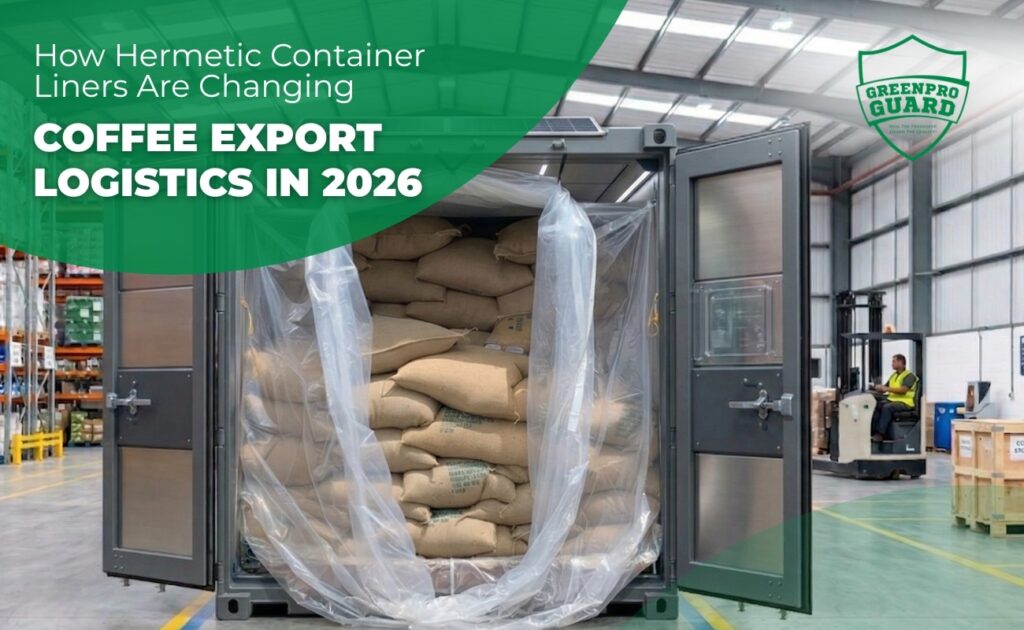
The hermetic container liner for coffee is one of the most significant innovations in coffee export logistics in recent years. A container liner is a large-format hermetic bag designed to fit inside a standard 20-foot or 40-foot shipping container. The entire container volume is lined and sealed before loading, turning the container itself into a single hermetic storage unit.
This approach directly addresses the condensation problem. When the container’s interior air is sealed before loading, the moisture content of that trapped air remains constant throughout the voyage. Container rain cannot form because temperature changes act on a fixed, sealed air volume rather than on coffee exposed to recirculating humid air.
For bulk exporters, the hermetic container liner for coffee also reduces packaging costs per unit. Instead of bagging every 60 kg individually, bulk green coffee can be loaded loose into the lined container. Loading speed increases, labor costs fall, and the hermetic protection is applied uniformly across the entire shipment rather than bag by bag.
Container liners are particularly valuable on long-haul routes such as Ethiopia to Japan, Colombia to South Korea, or Vietnam to Germany, where transit times regularly exceed 30 days, and the container passes through multiple climate zones.
How Hermetic Bags Improve Green Coffee Storage Solutions
For exporters working with smaller lot sizes, specialty micro-lots, or traceable single-farm origins, individual hermetic bags are the preferred green coffee storage solution. These bags are available in capacities ranging from 30 kg to 500 kg, covering the full range from small cooperative lots to commercial export quantities.
Key benefits of hermetic bags for green coffee export:
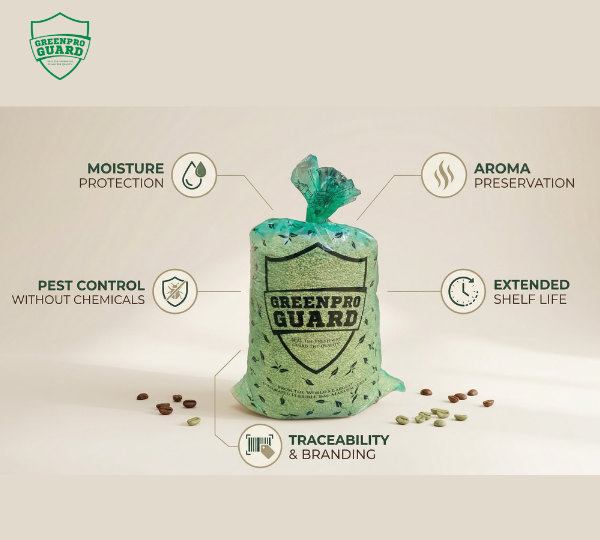
- Moisture protection: Multi-layer polymer film with near-zero water vapor transmission rate prevents both moisture ingress from external air and moisture migration between bags in shared storage
- Aroma preservation: An oxygen-free internal atmosphere halts oxidation of volatile aromatic compounds, preserving the cup profile the buyer expects based on pre-shipment sample approval
- Pest control without chemicals: Oxygen depletion inside the sealed bag eliminates insects without fumigant residues, supporting organic certification and meeting phytosanitary standards at destination
- Extended shelf life: Green coffee stored in hermetic bags can maintain export-grade quality for 12 to 18 months or longer, enabling exporters to time sales for favorable market conditions rather than selling under harvest season price pressure
- Traceability and branding: Hermetic bags can be printed with origin, lot number, and certification marks, supporting the provenance documentation that specialty buyers require
- Moisture protection: Multi-layer polymer film with near-zero water vapor transmission rate prevents both moisture ingress from external air and moisture migration between bags in shared storage
- Aroma preservation: An oxygen-free internal atmosphere halts oxidation of volatile aromatic compounds, preserving the cup profile the buyer expects based on pre-shipment sample approval
- Pest control without chemicals: Oxygen depletion inside the sealed bag eliminates insects without fumigant residues, supporting organic certification and meeting phytosanitary standards at destination
- Extended shelf life: Green coffee stored in hermetic bags can maintain export-grade quality for 12 to 18 months or longer, enabling exporters to time sales for favorable market conditions rather than selling under harvest season price pressure
- Traceability and branding: Hermetic bags can be printed with origin, lot number, and certification marks, supporting the provenance documentation that specialty buyers require
Moisture Control for Coffee Storage During Ocean Shipping
Container condensation is one of the least-discussed yet most costly problems in commodity shipping. The physics are straightforward. Warm humid air trapped inside a loaded container during loading at origin cools as the vessel moves into colder climates or crosses into nighttime temperature ranges. When the dew point is reached, water vapor condenses on the coldest surfaces inside the container, typically the metal roof and walls. This condensation drips onto cargo below.
Traditional desiccant products reduce ambient humidity inside containers but do not eliminate the condensation cycle completely. They require correct placement, adequate volume, and replacement across longer voyages. A single miscalculation in desiccant sizing can leave a shipment inadequately protected.
Moisture control for coffee storage during ocean shipping is most reliably achieved through hermetic sealing rather than humidity absorption. A sealed hermetic container liner or individual hermetic bags remove the coffee from direct contact with the container atmosphere entirely. Condensation may still form on the container walls, but it cannot reach the sealed coffee inside. The moisture control for coffee storage problem is solved at the source rather than managed after the fact.
The Future of Coffee Export Packaging in 2026
The global specialty coffee market is demanding more from exporters than ever before. Q-grade certifications, direct trade relationships, and traceability from farm to roaster have become table stakes in premium coffee commerce. The packaging decision is now part of the quality story that exporters tell to buyers.
In 2026, leading exporters across Brazil, Ethiopia, Colombia, Vietnam, and Indonesia are adopting hermetic container liner for coffee and hermetic bag systems as their standard coffee export packaging. The shift is driven by three converging forces.
-
- First, buyer rejection rates for moisture-damaged or off-spec coffee have increased as quality standards tighten. A single rejected container can eliminate an entire season’s profit margin for a mid-sized exporter.
- Second, sustainability requirements from European and North American importers are pushing exporters toward packaging systems that reduce chemical treatment. Hermetic storage eliminates fumigants from the storage and transit process.
- Third, the cost economics of hermetic packaging have improved substantially. Reusable hermetic bags and container liners now deliver a cost per kilogram of coffee protected that is competitive with conventional packaging when total post-harvest losses are factored into the calculation.
The exporters investing in hermetic infrastructure today are building a supply chain advantage that will only become more valuable as buyer expectations continue to rise.
Hermetic Storage Is Not Optional in 2026
Green coffee exporters operating in 2026 face a market that rewards quality and penalizes inconsistency. Moisture damage, mold contamination, flavor degradation, and pest infestation are not acceptable risks in a supply chain built on specialty premiums and direct buyer relationships. They are controllable risks. And hermetic technology is the most effective tool available for controlling them.
Whether applied as individual hermetic bags for specialty micro-lots or as full-container hermetic liners for bulk shipments, hermetic storage delivers a sealed, chemically clean, biologically stable environment that protects green coffee from the origin warehouse to the destination port.
For exporters who want to protect their quality, their buyer relationships, and their profitability through every shipment in 2026, hermetic storage is no longer a premium option. It is the standard that the market requires.
FAQ
Hermetic storage is the leading green coffee storage solution in 2026. Hermetic bags and container liners create airtight, oxygen-depleted environments that prevent moisture damage, mold growth, pest infestation, and flavor loss during long international shipping cycles.
A hermetic container liner seals the entire interior of a shipping container, isolating coffee from external humidity and condensation. This prevents container rain and moisture ingress across long voyages, protecting bulk green coffee through multiple climate zones without chemical treatment.
Yes. Hermetic bags eliminate oxygen inside the sealed environment, killing insects at all life stages without fumigants. This supports organic and chemical-free certification, satisfies phytosanitary requirements at destination ports, and removes fumigant residue concerns for sensitive import markets.
Green coffee stored in properly sealed hermetic bags maintains export grade quality for 12 to 18 months or longer when initial moisture content is within safe limits. This extends the exporter’s selling window and reduces pressure to sell at harvest season low prices.
Ocean containers experience condensation when temperature fluctuations convert humid trapped air into water droplets that fall onto cargo. Moisture raises coffee moisture content above safe thresholds, triggering mold, mycotoxin development, and grade downgrading that can result in full shipment rejection.